Rohingya Cultural Anthropology - Continued Page three
Part 4: Rohingya - neither Bengali nor Burmese
A study of the linguistic scenario also renders strong support to the abovementioned legends and history of Rohingya aboriginality, elucidating that they are neither Bengali nor Burmese.
It has been established that the Rohingya is a dialect within the Indic (Indo-Aryan) languages of Indo-European language phylum. Therefore, it is native to South Asia as per today’s geographical classification. Burma is included in the Southeast Asia. However, if we look at the map, say the Google Earth, we can easily see that Arakan of Burma is more of South Asia than of Southeast Asia. As a matter of fact, I have concluded that Arakan or the ancient legendary Rakkhapura was an extension of the Brahmaputra Civilization (p 223, The Rakhine State Violence, Vol. 2: The Rohingya). Therefore, it is reasonable to conclude that the Rohingya speakers are the indigenous to the region. On the other hand, the Rakhine language is an archaic dialect of today’s Burman language, which is classified as the Tibeto-Burman branch of Sino-Tibetan phylum. According to Professor Randy J. LaPolla, a distinguished scholar of linguistics the Sino-Tibetan language was originated in the Yellow River valley of China some 6,500 years ago (p 99, The Rakhine State Violence, Vol. 2: The Rohingya). As such, it is clear that the Tibeto-Burman speakers of Myanmar are the emigrants from north China. This squarely invalidates the assertion by the Myanmar scholars and authorities that Myanmar is a native land of the Tibeto-Burman speakers.
Furthermore, a Sino-Burmese scholar named Chen Yi-Sein who taught at Rangoon University and was a member of the Burma Historical Commission from 1956 to 1987, identified the Pyu of Taungdwingyi, central Burma, being the Dravidian speakers, contradicting the popular version that the Pyu were the Tibeto-Burman speakers. Current scholars like Michael Aung-Thwin, University of Hawaii at Manoa, has described that the Pyu musicians entertained with Sanskrit songs at the Tang Court in 800–802 as per the Chinese records. Pyu scripts are based on the Southern Indian Brahmi scripts. The artifacts found in various Pyu archaeological sites, dating from 1st to 9th century CE, were written in Pyu, Sanskrit or Pali. In addition, from the available archaeological artifacts we have good reasons to believe that Pyu belonged to the same stock of South Asian people such as Tamil. The native people of Taungdwingyi and Prome (pyay) region have dark skin color and the girls are popular as 'nyochaw' or 'brown beauties'. Burmese chronicles also mention that two blind Princes of Tagaung were cured to regain their eye sights by an ogre-nymph in the region of Shinma-daung and Mt. Popa, at the bank of Irrawaddy River. The ogre-nymph is, for sure, a dark-brown Dravidian speaking lady. The names, Mt. Popa (Puppha) and River Irrawaddy (Iravati) are not of Tibeto-Burman but are of Indic and Dravidian origin. In parallel, it is well-established that the Mon of Mon-Khmer people were in Burma long before the arrival of the Tibeto-Burman speakers. The Mon-Khmer language is in the family of Austroasiatic language phylum. In addition to the Mon, the languages of the Palaung and the Wa of Myanmar also fall in the family of the Austroasiatic languages.
There was no mentioning of Rakhine in Vesālī Ānandachandra Sanskrit stone inscription. The word Rakhine (Rakkhaing) first appeared only in the 14th century literature known as Shin Nagainda Mawgwun, an epic poem. It says they are known as the Rakhine (the guardians) because they safeguard two faculties such as Amyo (kindred) and Sila (religion). The Burmese script first appeared along with Pali, Pyu and Mon scripts in the Myazedi Stone Inscription made by Prince Raza Kumar of Pagan (Bagan) in 1113 CE. And it is believed that the Myanmar scripts were invented based on the Pyu scripts. As such, among the major languages and scripts, the Burmese language and scripts are the last to appear in Burma.
Today, the Rohingya language is unique with its own features within the Indo-European language family. It is also important to know that the Rohingya language is not legible to the Bengali and vice versa; however, a Rohingya can understand the Chakma language and vice versa, as pointed out by Dr. Muhammad Firdaus, M.D., FACP, an American physician of Rohingya ancestry, in USA. As such there is some affinity to each other between the Chakma and Rohingya languages. This intrigues me because Marayu, the founding king of Dhannyawadi is recorded to be the son of a Chakma woman and a Mauryan prince (The Rakhine State Violence Vol. 2: The Rohingya, pp 89-90). For sure, the Rohingya is not a Bengali dialect as concocted by the Myanmar authorities. Accordingly, we must reject the Burmese wrongful alienation of the Rohingya by calling them Bengali just because they speak an Indic but not Tibeto-Burman dialect. Finally, we must, with all due justice, respect the uniqueness of the Rohingya and its own identity, independent of Bengali and Burmese. Thereby, we must honor their rights to self-identification and self-determination.
Part 5: Rohingya - the aborigines and siblings
Today, no evidence is complete in the absence of genetics and DNA technology. There are two distinct lines of genetics inheritance, one from the mother and the other from the father. We can follow the genetic trail by tracing the genetic markers known as the haplotypes and those having the same haplotypes are grouped into the haplogroups. The genetic materials known as the mitochondrial DNA or mtDNA is uniquely inherited from the mother only. Therefore, from the studies of the mtDNA, we can trace the origin of our maternal ancestry way back to the remote time of human evolution. In light of present knowledge, it is established that our Mitochrondrial Eve lived some 194,000 years ago, possibly somewhere in East Africa, and she carried the macrohaplogroup L. The mother macrohaplogroup L branched out to L1-6 macrohaplogroups. It would appear that the early human who had mtDNA macrohaplogroup L3 came out of Africa probably some 94,000 years ago. From the macrohaplogroup L3 emerged the macrohaplogroups M and N, as early as some 62,000 years ago. All the European population carries the macrohaplogroup N whereas the Asian population, from the Indian Subcontinent, Southeast Asia to Far East, has the mcarohaplogroup M. The mother's mtDNA is a better indicator of the aboriginality of a local group because it is men who usually migrate or invade. For example, from the studies of Venezuelan population genetics we know that all the paternal Y-chromosome comes from almost exclusively of the European invaders while the maternal mtDNA is purely of the indigenous women, indicating that the indigenous males were wiped out.
In a study of 44 complete mtDNA sequences of Myanmar people by M. Summerer and his colleagues (BMC Evolutionary Biology, 2014, 14:17, pp 1471-2148) they found that all Burmese mtDNA fall in the macrohaplogroup M. Most interestingly, M. Metspalu and his colleagues (BMC Genetics 2004, 5:26, pp 1471-2156) discovered that the frequency of macrohaplogroup M peaks at 86% at West Bengal, indicating that Bengal serves as the Grand Central of human migration from South to East and Southeast Asia. Therefore, it is not surprising when HUGO Pan-Asian SNP Consortium, consisting of 92 scientists (Science, 2009, 326: pp 1541-1545), concluded, "the evidence from our autosomal data and the accompanying simulation studies...point toward a history that unites the Negrito and non-Negrito populations of Southeast and East Asia via a single primary wave of entry of humans into the continent." In other words, it is not wrong to say that Bengali women are the mothers of all Southeast and East Asian population that includes the Burmese as well.
As such, the entire population of South, East, and Southeast Asia is connected by the mtDNA macrohaplogroup M and all are the descendants of the Asian Negritos. This is in absolute agreement with the statements of U Kyaw Min and U San Tha Aung that the earliest people of Arakan are Negritos. Thus, there is overwhelming agreement between science and legend supporting the Rohingya existence since the time immemorial and they are known as Raksha or Bilu (meaning dark and ugly ogre) in the Myanmar chronicles. It is excitingly so because Raksha or Bilu are the guards of Mt. Meru and the Rohingya today are concentrated in the region of Mt. Mayu, which is the physical representation of the Buddhist cosmological Mt. Meru. The Buddhists must be very grateful to the Rohingya for safe-guarding their sacred mountain since the beginning of the world.
Beyond doubt, with the science of modern genetics, it confirms that the Rohingya, who appears to be a modern image of our ancestral Negritos, are the aborigines of Arakan. Now, the Burmese still call the Chinese 'paukphaw', meaning 'sibling', reflecting their historical cultural lineage. I would like to suggest that the Burmese may also call a Rohingya 'paukphaw' because he is also a sibling in light of the anthropological genetics. Again, based on the population genetics, we also know with certainty that of the total three billion DNA nucleotides in our human genome 99.99% is the same in the entire human population. As such, we all are siblings.
Part 6: Rohingya - the victims of civilization
In the days of Arakan Kingdoms, there were slavery and discrimination, but there was no recorded communal violence or ethnic cleansing. The same is true during the days of British rule. The Rohingya problem emerged only when the British withdrew in 1947-48, and the three nation states known as Pakistan, India and Burma were created. Many peoples got divided along the new border lines. The biggest example is the division of Great Bengal into lesser West Bengal and East Bengal within India and Pakistan respectively. East Bengal, in 1971 violently broke off from Pakistan to become an independent sovereign nation, Bangladesh. The smaller peoples, such as Baloch, Kashmiri, Naga, Mizo, Manipuri, Chakma, Rohingya, Rakhine, Chin, Kachin, Shan, Kaya, Karen, Mon etc., are not that fortunate. The Rohingya are the worst because they got cemented at the bottom of the Myanmar racial hierarchy, as illustrated below.
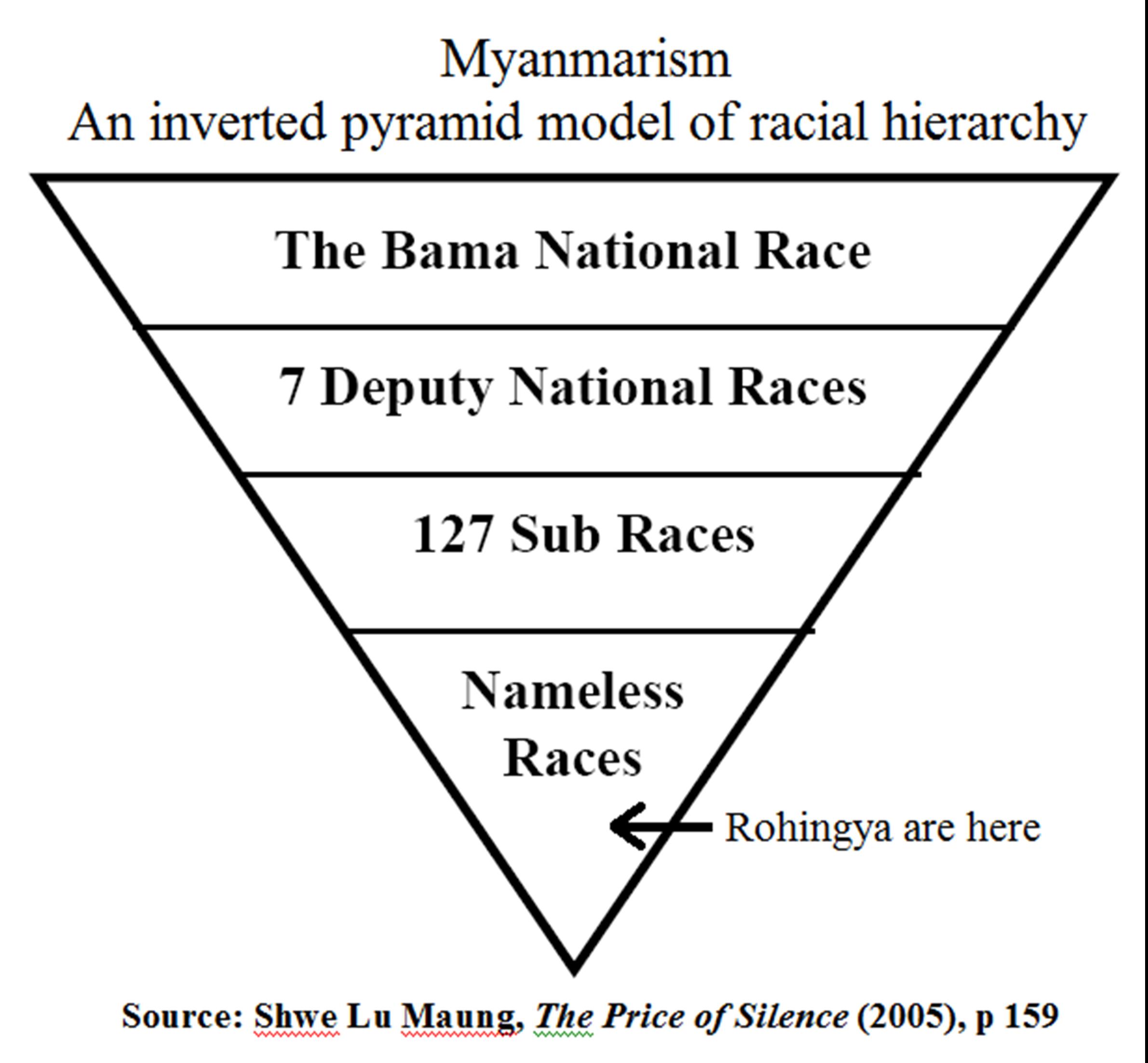
The Rohingya dilemma began when their ancestral region was divided into Pakistan (now Bangladesh) and Burma, along the midstream of Naaf River. They are agriculturists and fishermen, and still are nomadic to some extent. Their ancestral land runs along the east and west Banks of Naaf River. They were caught in the brand new nationalism and citizenship acts of Pakistan and Burma. They had no understanding of what the heck a nation state or citizenship is in the modern civilized world. All they knew was that their freedom had been severely restricted and their villages were divided by the demarcation of a border line running in the middle of their ancestral land. In confusion, chaos and rebellion broke out. U Nu Government of Burma settled the situation in a peaceful manner, which is well reflected in the speech of Brigadier General Aung Gyi on the 4th of July 1961 when he welcomed the end of armed insurrection of some 200 Rohingya. Aung Gyi's speech reads as follow in my English translation from the original Burmese that appeared in the Khit-ye Sa-saung (p 31, The Rakhine State Violence, Vol. 2: The Rohingya).
- "First, I would like to talk about the matter that is concerned for all people of Mayu District. Our Mayu District is bordered in the West with Pakistan. Due to the border connection there are people of Muslim religion both at the East and West sides of the border. The people at the West [of the border] are called Pakistani and those at the East [of the border] inside Myanmar are known as the Rohingya. I would like to say this: This place [Mayu District], which is connected with Pakistan, is not the only place where the same “kind of people” (Lumyo) lives at both sides of the border."
Then, he gave the examples of Lisu, E-kaw, La-Wa, Shan living inside Myanmar and China, and Tai, Mon, Karen inside Myanmar and Thailand. After that he said the following.
"At this moment, before the audience, I would like to say openly and precisely. People in the bordering regions have relatives on either side. Despite having the relatives, those who live over there must be Pakistani and those who live here must be citizens of the Myanmar Union."
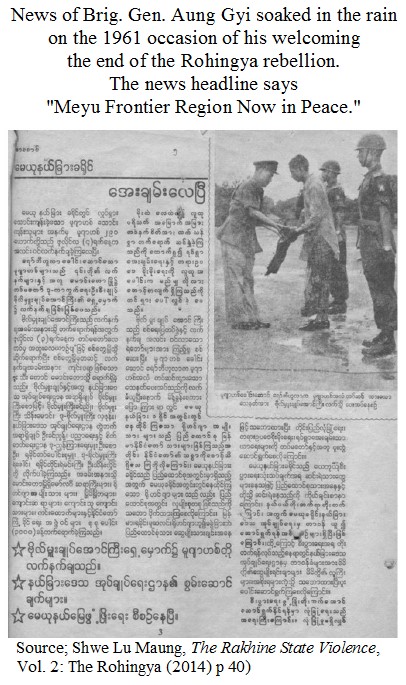
Thus, U Nu Government implemented peace and citizenship to the Rohingya. The problem was solved and ended there, in 1961. However, in 1962, most unfortunately, General Ne Win and his army seized power, abolished all democratic institutions, and introduced militarized ultra-nationalism and racial hierarchy. With hate ideology, Myanmar’s ethnic cleansing of Rohingya has reached to a point of genocide and crimes against humanity. For long 55 years from 1962 to 2017, the civilized world did nothing. U Nu had said, "It is a sin to kill, but it is a greater sin to watch the killing with folded arms." As long as the world remains silent with folded arms the Rohingya and their alike will be suffering in the hell of civilization.
About the author: Dr. Shwe Lu Maung is an author of several books on Burma (Myanmar), and is a living authority on his native Rakhine (Arakan) state. He is a scientist by training and profession and claims to be a social Darwinist. Before settling in the USA, he spent decades living both in Burma and Bangladesh.


The Journal of America Team:
Editor in chief:
Abdus Sattar Ghazali
Senior Editor:
Prof. Arthur Scott
Disclaimer and Fair Use Notice: Many articles on this web site are written by independent individuals or organizations. Their opinions do not necessarily reflect those of the Journal of America and its affiliates. They are put here for interest and reference only. More details


Your donation
is tax deductable.


Article by
Journal Writes