The Jerusalem Question (Continued P-3)
By mid-19th century, with the weakening of the Ottoman Empire (to the extent of being ridiculed as the “Sick Man of Europe”) the European colonial powers vied with each other to gain a foothold in Palestine. New areas with names like the German Colony and the Russian Compound sprouted the city. According to Zionist historiography, residential building outside the walls of the Old City began around 1860 with the Jewish settlement – Mishkenot Shaananim. However, such scholarship overlooks the much earlier construction and continued use of numerous indigenous residential buildings outside the walls such as khans, residences for religious persons, and summer homes with orchards and olive presses, belonging mostly to non-Jews, especially the Arab Muslims. [12] In time, as the communities grew and connected geographically, this became known as the New City. [13]
This was also an age of Christian religious revival, and many churches sent missionaries to proselytize among the Muslim and especially the Jewish populations, believing passionately that this would expedite the Second Coming of Christ. These outside missionaries settled in and around places like Bethlehem and Jerusalem.
In 1846 there were only 12,000 Jews in Palestine out of a population of 350,000. In 1880, shortly before the Russian Pogroms, there were only 25,000 Jews in Palestine out of a population of half a million. [14]
The last half of the 19th century witnessed the pontification of Pope Pius IX (1846-78), the publication of Wilhelm Marr’s "Jewry’s Victory over Teutonism" (1873), the assassination of Czar Alexander II (1881) and the Alfred Dreyfus case (1894). [15] These events led to pogroms and anti-Semitism (actually Jew-hatred) across Europe, especially in Eastern Europe and Russia. Jews again found refuge in the Ottoman Empire. [Ironically, the demise of the Ottoman regime can partly be blamed on the Jewish enclave in Salonika (now Thessalonica or Thessaloniki in Greece) – home of the Donmeh[16] and the birthplace of the (Jacobin) Young Turk movement.] [17]
The last decade of the 19th century saw the emergence of political Zionism calling for the establishment of a Jewish state. Sultan Abdul-Hamid, the last of the Ottoman Sultans, was approached by Theodor Herzl, the father of political Zionism, who offered to buy up and then turn over the Ottoman Debt to the Sultan’s government in return for an Imperial Charter for the Colonization of Palestine by the Jewish people. In his Diary, Herzl writes, “Let the Sultan give us that parcel of land [Palestine] and in return we would set his house in order, regulate his finances, and influence world opinion in his favour…” The Sultan rejected the offer, but reiterated that as the Caliph he remained a guardian of the Jewish people.
Herzl personally met the Sultan in May 1901. The American Jewish Yearbook[5663, October 2, 1902, to September 21, 1903, ed. Cyrus Adler, Philadelphia, the Jewish Publication Society of America (1902)] at the time summarized Herzl's meeting this way:
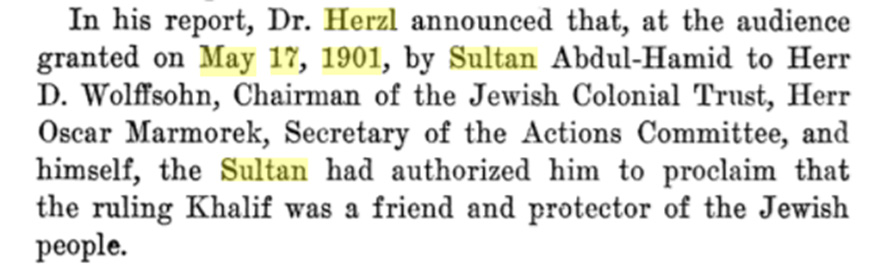
[Note: The Jewish Yearbook cited above also shows that at the Fifth International Congress (of Zionists), held at Basel, Switzerland, from Dec. 26 to 29, 1901, a system was designed to uniting the various Zionistic societies under one umbrella, the Congress, and the Congress was to establish a National Fund of 200,000 British Pound to be used for the purchase of land in Palestine.]
In his letter to a Sufi Shaykh - Shadhili Sheikh Abu'Shamat Mahmud (dated Sept. 22, 1911), Sultan Abdul-Hamid mentions this episode: “I left the post of the ruler of Caliphate only because of the obstacles and threats on the side of people who call them ‘Young Turks’. The Committee of Unity and Progress obsessively insist on my agreement to form a national Jewish state in the sacred land of Palestine. But in spite of their obstinacy I strongly refused them. In the end, they offered me 150 million English pounds in gold, but again I refused and said the following to them: ‘If you offer me gold of the world adding it to your 150 man [measure of weight], I won’t agree to give you the land. I have served Islam and the people of Muhammad (S) for more than 30 years, and I won’t cloud the Islamic history, the history of my fathers and grandfathers - Ottoman Sultans and caliphs.’ After my definite refusal, they decided to remove me from power, and after that they told me that they would transport me to Salonika and I had to resign. I praise my benefactor who didn’t let me bring shame on the Ottoman state and the Islamic world. I want to stop at this. I praise the Almighty once again and finish my letter.”[18]
The Sultan, to the last of his days, resisted bartering Jerusalem for his reign.
So, what we notice from historical accounts is a remarkable Muslim reverence for the city of Jerusalem, much in contrast to the disingenuous claims made by Zionist apologists like Daniel Pipes and others. Down the centuries, from the time of Umar (R) to the subsequent Muslim dynasties ruling from Damascus, Baghdad, Cairo and Istanbul, Jerusalem was always important to Muslims. They constructed a wide variety of buildings and institutions in Jerusalem: mosques, theological college convents for Sufi mystics, abodes for holy men, schools of the Hadith and the Qur’an, orphanages, hospitals, hospices for pilgrims, fountains, baths, pools, inns, soup kitchens, places for ritual ablution, mausoleums, and shrines to commemorate the Prophet’s (S) Mi’raj. These buildings were maintained through a system of endowment in perpetuity (awkaf), sometimes involving the dedication of the revenues of entire villages in Palestine, Syria, or Egypt. The patrons were caliphs and sultans, military commanders and scholars, merchants and officials, including many women. Their philanthropy bears witness to the importance of Jerusalem as a Muslim center of residence, pilgrimages, retreat, prayer, study and burial.[19]
British Mandate Period:
With the defeat of the Turkish Army during the World War I (1914-18), British General Edmund Allenby took control over Jerusalem. Upon entering the city on 11 December 1917, he declared, "Now the Crusades come to an end." As a matter of fact, it was the beginning of the end, i.e., marshalling of a neo-crusade against Muslims by using Israel as a ‘rampart’ in the Muslim heartland.
In 1917, Britain issued the infamous Balfour Declaration promising the Zionists establishment of a Jewish national homeland in Palestine. The Declaration was criminal to the core as historian Arthur Koestler so aptly described: “One nation solemnly promised to give to a second nation the country of a third nation.” [20] With that goal in mind, during the devious British Mandate (1917-47), Jews were pumped into Palestine from all over Europe. Despite such Jewish influx, according to a census taken by the British on 31 December 1922, there were altogether 83,000 Jews in Palestine out of a total population of 757,000 of which 663,000 were Muslims. [21] That is, the Jewish population was only 11%.
In 1935, when the Palestinian Arabs rose in revolt against further Jewish immigration, there were 370,000 Jews out of a total population of 1,366,670, i.e., 3 out of 4 were Arabs. [22] During partition, the Jewish population owned less than 6% of the total land in Palestine. [23] Yet when on November 29, 1947, the UN voted to partition Palestine into Jewish and Arab states, with Jerusalem in an international zone, 56% of the total area was allotted to the Jewish state. As was expected, Arabs (except for King Abdullah of Transjordan) rejected the plan and a fight for territories broke out in which armed Jewish terrorist gangs massacred unarmed Palestinians in several villages. [24] At that time, in Old (East) Jerusalem Jews owned less than 1% of land. Their ownership of properties in the New (West) city was 26%. [25]
In recent years, the issue surrounding pre-1948 demographics of Jerusalem has become a hot item. Zionist historiographers (e.g., Ben Arieh, Gilbert and others) have been trying to prove a Jewish majority in Jerusalem before the partition. This myth has no support and is debunked by the available late Ottoman-era statistics and (for the later period) by examining the boundaries of the Jerusalem Municipality as drawn by the British Mandatory authorities. [26]
In this regard, it is worth quoting what pre-eminent demographer Justin McCarthy had clearly pointed out, “Ottoman statistics are the best source on Ottoman population.” [27] The Ottoman data on Jerusalem show that in 1871-2, the Jewish population of Jerusalem was a quarter of the total population living in Jerusalem. In 1895, when the city’s population was about 43,000, the entire Jewish population could not have been more than a third (i.e., 14,500). In 1912 – the last Ottoman statistics – show that Jerusalem had a total population of 60,000 of which nearly 25,000 were Jews. [28]
According to Professor Walid Khalidi the international zone comprising “Mandatory municipal Jerusalem” in addition to some 20 surrounding Arab villages had a slight majority of Arab population who numbered 105,000 while the Jewish population was just under 100,000. [29] Academic research works by Salim Tamari (director of the Institute of Jerusalem Studies and a professor in the Department of Sociology and Anthropology at Birzeit University) and others present a similar picture. They point out how Zionist historiographers deliberately avoided accounting for Arab neighborhoods in their demographic studies of Jerusalem while concentrating mostly on Jewish suburbs.
Upon reviewing the literature on the selective demographics of Mandate Jerusalem, British historian Michael Dumper attributes two major reasons for these population discrepancies. [30] First, estimates counted Jewish migrants who arrived in Jerusalem before 1946 and later moved to Tel Aviv and other localities. Second, while excluding Palestinians who were working in the city but living in its rural periphery (the daytime population such as the commuting workers from Lifta and Deir Yasin), they included Jewish residents living in suburban areas such as Beit Vegan, Ramat Rahel, and Meqor Hayim. The latter were incorporated within the municipal population through a process he refers to as "demographic gerrymandering.” [31]
Professor Tamari’s studies on Jerusalem’s western villages, for instance, show that once the rural neighborhoods are introduced, the picture regarding demographics and land composition change dramatically. “Extrapolations from 1945 Mandatory statistics,” Professor Tamari says, “show that the Jerusalem sub-district contained slightly over a quarter of a million inhabitants of whom 59.6% were Arabs and 40.4% were Jewish. In the western Jerusalem areas that came under Israeli control after the war (251,945 dunums) 91.8% (231,446) dunums were Arab owned, 2.7% were Jewish owned, and the rest were public lands.” [22]
Israeli Period:
The conspiracy of the Western powers in collusion with the Zionists, the terrorism inflicted upon the Arab inhabitants, the foolishness of the local leaders, and the incompetence or indifference of others – all these led to the establishment of the state of Israel on May 15, 1948 when on that day the Jewish settlers declared independence. The massacre of Arab residents of Deir Yasin, Qibya and Kafr al-Qasim that followed were only the preludes to Israel’s genocide of Palestinians at Sabra and Chatilla, Tyre and Sidon, Nablus, Jenin and of ongoing atrocities in Gaza, West Bank and Southern Lebanon. [33]
Soon after the unilateral declaration, in a subsequent war with neighboring Arab states, Israel captured 78% of the original Palestine by annexing territories set for the Arab Palestinian state, leaving only East Jerusalem, the West Bank and the Gaza Strip in Arab hands. This cataclysmic event forced 750,000 Palestinians to seek refuge elsewhere.
As to its impact on Jerusalem, Professor Tamari writes, “During the war of 1948, particularly during the months of April-May, about 25-30,000 Palestinians were displaced from the urban suburbs of Jerusalem. In addition, the bulk of the village population (23,649 rural inhabitants) were also expelled. These included the population of the two largest villages in the Jerusalem sub-district, Ain Karim and Lifta, and virtually all the rural habitations west of the city (except for Abu Ghosh and Beit Safafa). Altogether 36 villages and hamlets were destroyed, or – as was the case with Lifta and Ain Karim – were physically left intact but their Palestinian inhabitants removed. Most of the displaced persons eventually found refuge in the Old City and its northern Arab suburbs (Shu’fat, Beit Hanina, Ram), and in the refugee camps of Ramallah and Bethlehem. Today the refugee population originating from the Jerusalem district is estimated to be 380,000.” [34]
In July 1949, the Israeli government declared West Jerusalem "territory occupied by the State of Israel", and all Arab lands and businesses were confiscated under the Absentee Property Regulations of 1948. Most of the urban refugee property in Jerusalem was sold to Israelis and squatters. Refugee-lands outside the urban center were mostly sold to a specially established Government Development Authority which in turn sold them to the Jewish National Fund or to cooperative agricultural settlements. Soon, Israel began to transfer its government offices to Jerusalem from Tel Aviv. Government employees were housed in abandoned refugee property. [35]


The Journal of America Team:
Editor in chief:
Abdus Sattar Ghazali
Senior Editor:
Prof. Arthur Scott
Disclaimer and Fair Use Notice: Many articles on this web site are written by independent individuals or organizations. Their opinions do not necessarily reflect those of the Journal of America and its affiliates. They are put here for interest and reference only. More details


Your donation
is tax deductable.


Article by
Journal Writes